
Fashion and Flourish – Making a Statement!
Following on from our first instalment of fashion in the 15th Century, we are now moving further up the social ladder, and things start to get a little flashier. The simple wool gowns and sturdy linen shifts of the working classes give way to pleats, furs, slashed sleeves, and rich colours. Here, fashion becomes less about practicality and more about display, as men and women with some wealth to their name invest in clothing that shows off their status.
Stepping Up in Style
We start with a prosperous townsman – not a noble, but someone doing well enough to keep pace with fashion. His pleated shoulders made a subtle statement that he could afford to spend more on fabric than the bare minimum as they consumed more fabric, and fabric cost money. On his head sits a black hat, fashionable for the time and another nod to the fact that he is not living hand-to-mouth.
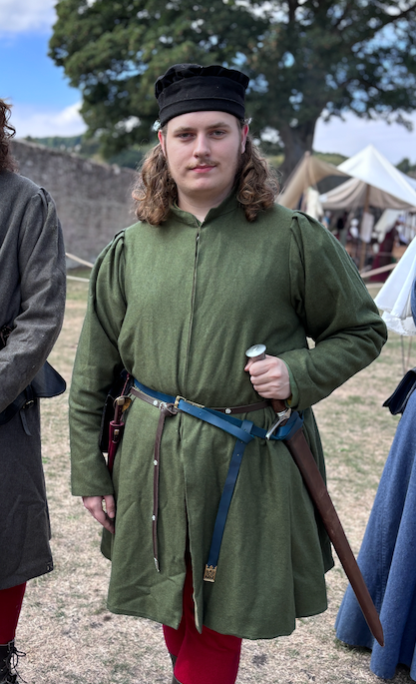
Townsfolk of middling means.
An Italian Visitor
Our journey then takes a detour to Italy – or at least to a man dressed in the style of an Italian visitor. He wears silk damask, a far cry from the sturdy wools of the townsfolk, with a doublet cut in a style that differs from English and French fashion. Instead of the triangular silhouette that was popular across northern Europe, Italian tailoring favoured a more rectangular line. His mutton chop sleeves emphasise this difference, setting him apart immediately.
Silk itself mattered enormously. Unlike wool, which was England’s own great industry, silk had to be imported at great cost. To appear in it was to signal international connections, wealth, and a taste for luxury. Even a modest grade of silk damask suggested independence and prosperity.

Silk sets this gentleman apart. Image Credit: Cheltenham Media
Fur, Slashing, and Rich Colours
As we progress further up the social scale, clothing becomes more elaborate. Men begin to wear fur-lined gowns, instantly marking themselves as wealthier. Fur was warm of course, but it was also a symbol of privilege. The more exotic or expensive the fur, the higher the status it conferred.
Many gowns are slashed at the sleeves, revealing bright silks beneath. This wasn’t simply a flourish: it was another way of declaring that you could afford to line your clothing with costly fabrics instead of plain wool. Even the hose – the fitted leg coverings tied to the doublet – become more fashionable here, appearing in bold shades of black or green rather than the plain, undyed hues of the lower ranks.
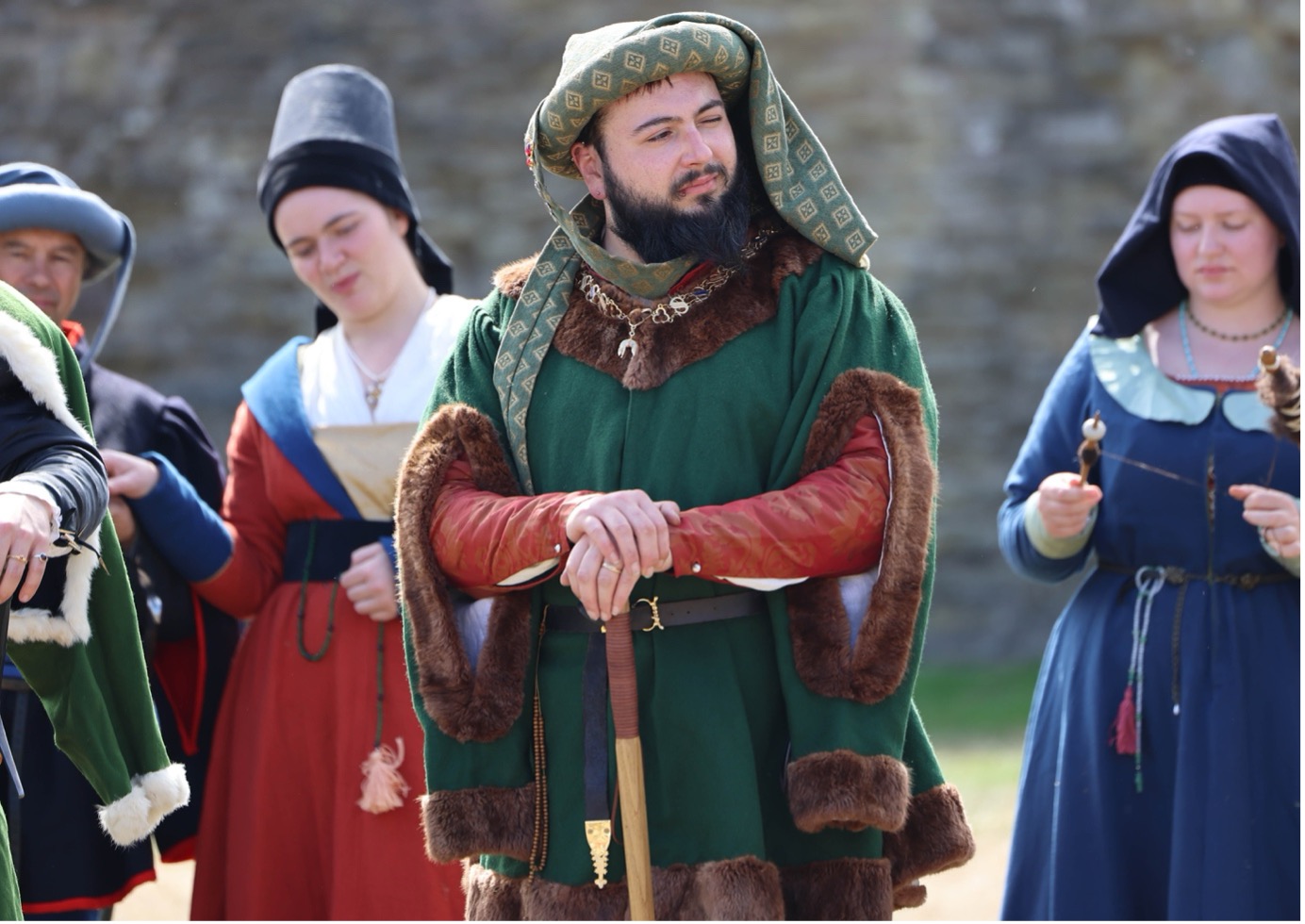
Slashed sleeves, fur and rich colours. Image Credit: Cheltenham Media
Colour as Currency
Colour itself was a form of wealth. Producing deep, saturated dyes was an expensive process, requiring imported ingredients and skilled work. As a result, the richer and darker the colour, the higher the cost. A vibrant crimson or a deep green was a clear step up from the paler, more muted tones of modest clothing. To the medieval eye, colour was as much a signal of prosperity as silk or fur.
Clothing in the 15th Century was a spectrum of subtle signals and bold statements. By now, it is clear that what you wore was every bit as important as what you did.
Our whistlestop tour of fashion continues in Part 3, where we enter the world of the nobility. Think sweeping gowns, elaborate headwear, and even armour lined with silk! Here, practicality gives way entirely to pageantry…